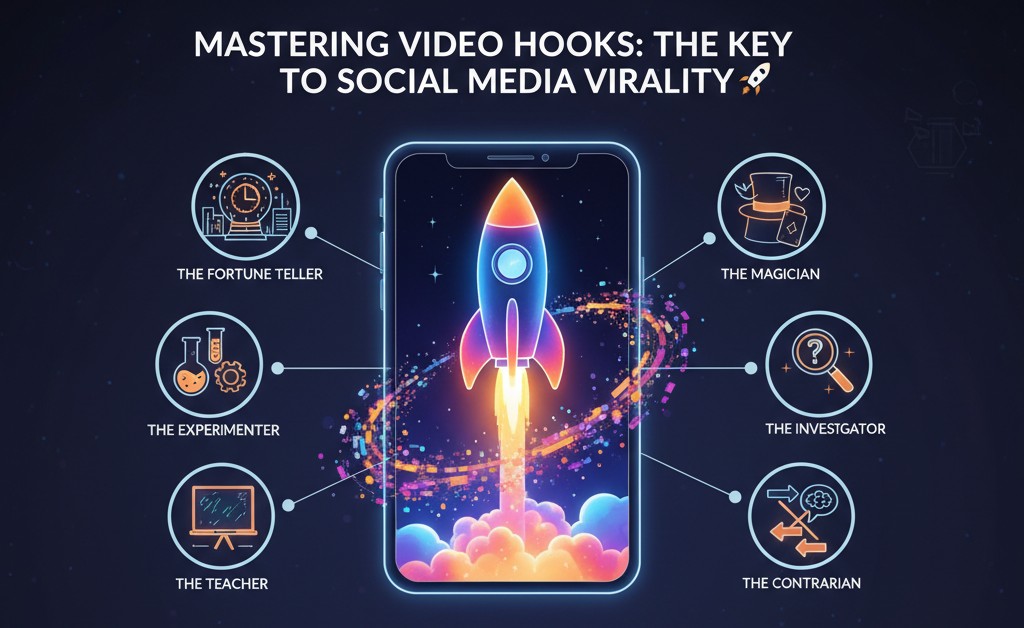
Did you know the biggest difference between winning and losing on social media is the hook? It’s the 80/20 rule of video: focusing on hooks can significantly improve video performance. A recent deep dive into the psychology and tactics behind viral video hooks revealed key insights.
Hooks are designed for one reason: to create a curiosity loop in the viewer’s brain. The goal is to make viewers curious enough about the topic that they couldn’t imagine doing anything else but watching the video. The best way to create that curiosity loop is with contrast. Viewers may start believing one thing (A), and then an alternative (B) is introduced in the hook; the greater the distance between A and B, the deeper the curiosity and the hook. There are only about 5 seconds to make it stick!
All top-performing videos utilize one of six different hook formats:
✅1. The Fortune Teller: Positions the present against the future, building curiosity about how things might change. This format is excellent for breaking news or product innovations.
✅2. The Experimenter: Showcases how something works through a demo or experiment, often angled as peer-to-peer, like a friend sharing what they learned. This is ideal for product demos and B2B tools.
✅3. The Teacher: Frames a lesson, explaining a method or solution to a pain point, similar to a teacher instructing a student. This format is effective for building authority or showcasing expertise.
✅4. The Magician: Employs strategic visuals, sounds, or language (e.g., “hey look at that”) to visually force the viewer’s attention to something specific and often outlandish or rhythmically captivating, designed to stop the scroll. This hook can be combined with any of the other five.
✅5. The Investigator: Creates contrast around an unknown secret or a research finding that nobody else knows. The contrast is simply between not knowing a thing and then being shown it. This is great for those at the leading edge of their field.
✅6. The Contrarian: Directly states a belief about a topic that differs from conventional wisdom, making the contrast immediately clear. This format is straightforward and effective for experts who offer dissenting views.
Tactical Steps for Crafting a Banger Hook:
A hook consists of four components: spoken, visual, text, and audio. The secret to achieving high views (e.g., 500k vs. 500 views) lies in unlocking maximum alignment between these four elements. Misalignment leads to confusion and comprehension loss, making it harder for the viewer to stick with the hook.
✅1. The Key Visual is Paramount: Viewers process information as visual -> audio -> visual, with eyes processing information 10 to 100 times faster than ears. Therefore, the most important part of a hook is the visual. Start by identifying the compelling visuals available for the first 3-5 seconds. If a strong visual is lacking, it may be worth reconsidering the video idea or manufacturing a strong visual element. This is referred to as the key visual.
✅2. Identify Contrast: Based on the key visual, identify the most interesting facts or angles about the story that offer the biggest contrast. This contrast will inform which of the six hook archetypes to use.
✅3. Write the Spoken Hook: Craft 2-4 lines that align perfectly with the chosen visual and format.
✅4. Add Text Hook: Overlay text on the screen to support the initial visual and reconfirm it after the viewer hears the speech.
✅5. Gut Check for Comprehension: Watch it back. Does the viewer clearly understand what is being discussed if they process it as visual -> speech -> visual? Does it align with the rest of the video? If not, rework the hook – its importance cannot be overstated.
A perfect hook ensures clarity and alignment across all elements, preventing comprehension loss. For instance, a video about “life-size floor plans” garnered 15 million views because the visual of people walking on projected floor plans served as a clear “visual shocker,” perfectly aligned with the “fortune teller” hook: “This is the future of Home Design”. Text that read ’life-size floor plans’ with an arrow was strategically placed to guide the viewer’s eye to the desired visual. That visual was identified as a strong key visual to build upon. When looking at the formats, two made sense: the fortune teller (‘This is the future of Home Design’) and the secret keeper (‘A secret about home design that nobody knew’). The fortune teller format was chosen for its ease of explanation and ability to create a greater shock. The hook was crafted to include a magician-style scroll-stopper (‘Check this out’). It then presented the context: ‘These are life-size floor plans. You can literally walk through your exact Home Design before you build it.’ This description perfectly aligned with the visual being shown. A contrasting word was not necessary as the mere existence of the visual already provided sufficient contrast. The ‘contrarian take,’ aligning with the fortune teller hook, was ‘This is the future of how people are going to design their homes’. This demonstrated a tailored approach to hook building with pure alignment, contributing to the video’s 15 million views.
Conversely, a poorly executed hook can lead to comprehension loss. For example, a video attempting to visualize “the future of storytelling” with abstract rooms and complex terms like “generative World model” suffered from misalignment between visuals, text, and speech, resulting in significantly lower views. Perhaps a more explicit approach would have been to frame these rooms as “the future of commercials,” supported by visuals of individuals utilizing the rooms to film commercials, which could have provided a clearer perspective. If clarity and alignment are absent, it is often better to discard the video idea, as better ideas will always emerge.
❤️
#SocialMediaMarketing #VideoMarketing #ContentCreation #Hooks #Virality #LinkedInTips